Thursday, May 31, 2012

The Ruin of Poland 3

This is the third installment in The Ruin of Poland.


Here is the quote:

The frontier opposite the Posen bulge was held defensively by German reserve troops, but on their right to the southward the Eighth Army (seven divisions)whose task was to cover the left flank of the main thrust. This thrust was assigned to the Tenth Army (seventeen divisions) directed straight upon Warsaw. 


Now I'll explain what he's talking about.

 On the left of the Tenth Army was the German reserve troops, who where not supposed to go into battle until the German High Command told them to. On the right was the Eighth Army which was to cover the Tenth army and make sure that no Polish troops (especially from the cities of Posen and Lodz) did not come near the main thrust to Warsaw.
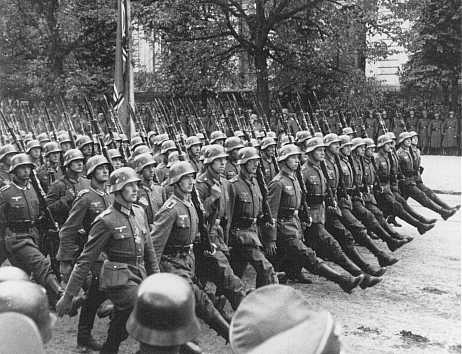
next time I will take a break from this and show you some pictures I took in London.                                                                                                                                                                                                                                                                                                                                                                                                                                                                                                                                                                                                                                                                                                                                                                                         

Saturday, May 12, 2012

The Ruin of Poland Part 2

This is the second part of The Ruin of Poland, by Winston Churchill. I will be going through this chapter which is called The Ruin of Poland. I will be doing this post and the other posts about this    chapter the same way as the first post in this section on Winston Churchill's book.

Here is the quote:

     From Pomerania the Fourth Army  (twelve divisions ) was ordered to destroy the Polish troops in the Danzig Corridor, and then move south-eastwards towards Warsaw along the Banks of the Vistula.

Now I'll explain what he is talking about.
Pomerania is in the northern part of Germany,so the Fourth Army was to cut across to the city of Danzig, destroy the Polish troops there, and the split up in half and go down the banks of the Vistula river, one half on each side, and march toward the capital city of Warsaw.

That's all for now... next time ill do a little more on The Ruin of Poland

If you have any questions or comments, please post a comment and I will try to respond.

Friday, May 11, 2012

The Ruin of Poland


One book I have been working through recently is Winston Churchill's book The Gathering Storm. For this post I will be talking a little about the attack on Poland.I'll give a quote from the book about this and then go into a little detail about what he is talking about.

Here is the Quote:


Meanwhile around the Cabinet table we where witnessing the swift and almost mechanical destruction of a weaker State according to Hitler's method and long design. Poland was open to German invasion on three sides. In all fifty-six divisions, including all his nine armored and motorized divisions, composed the invading armies. The Third Army (eight divisions) advanced on Warsaw and Bialystok.

End quote.

Now I'll explain what he is talking about.
The Cabinet that he mentions in the beginning of the quote is the British War Cabinet. Hitler had been  plotting this invasion for months before the actual day... he had even staged a mock Polish attack on Germany! He took some dead prisoners, put them in Polish uniforms, and put them where the "invasion" was supposed to have taken place! So in this way he staged his attack on Poland as a retaliation on Poland. Hitler was putting all he had at the time into this invasion. He had all his armored and motorized divisions into the attack. (Armored and motorized machines includes tanks, artillery, troop transport vehicles, and motorcycles.)

That's all for this post, next post I'll cover a little more from this chapter in The Gathering Storm.      

Thursday, May 10, 2012

  
Lexington and Concord                       


          If you where in Boston, on April 19, 1775, at around 7:00 pm, you would see British regulars straggling through the streets. “How did this happen?”, you might ask. Well, I’d like to tell you.

          On April 18, 1775, silversmith Paul Revere received an urgent message from Dr. Warren. It said that the British are going to come from Boston to capture the gunpowder stored up by colonials. They would also go and arrest John Hancock and Samuel Adams, leaders of the Sons of Liberty, who were opposed to the British. Paul was to warn John and Samuel and to tell the local militia that the British were coming by sea.

          So Paul alerted the colonials and soon militiamen were pouring into Lexington Green, the British first checkpoint. The Militiamen waited for hours, after a while, many went home. Finally a lookout runs up and says to Capt. John Parker, “The Redcoats are coming!” In all, there are 70 militiamen at Lexington Green. All of a sudden, 240 British regulars march onto the Green.

          At 7:20 am. Major John Pitcairn, a British officer, rode up and shouted to the militia, “Disperse ye rebels disperse, and lay down your arms!” Capt. John Parker said, “Fall back, but remain armed.” The militiamen start walking away, however, a few stay. Then a shot, “The shot heard ‘round the world. Both sides exchanged fire for around 10 minutes. In all, 8 militiamen died and 10 were wounded. Only 2 Redcoats where wounded, one in the leg and another in the finger. The militiamen retreat, for the moment! However, they gather in large numbers in Concord, the British second checkpoint. But this time the colonials didn’t run, they fought back. One British survivor remembered, “They marched toward us in a very military manner.” The British set fires in Concord. One militiaman asks Col. Barrett, “Will you let them burn the town down?”Col. Barrett, a militia officer, orders his troops to North Bridge, where there were around 100 redcoats guarding the bridge. They exchange fire at around 200 yards distance. Two Americans are killed and several are wounded. Col. Barrett shouted, “Fire, for God’s sake fire!” The Americans return fire, killing and wounding around 15 redcoats. The British retreated as 3,600 militiamen from over 40 towns pour into Concord and the surrounding countryside. The British retreat along Battle Road which is 20 miles long. The British finally started to straggle into Boston at around 7:00 pm. The British suffered over 300 dead, wounded or missing, while the Americans only suffer 100 casualties.

          Today, you can visit the location of the first battle of the American Revolutionary war at Minuteman National Park.

          I have only given the general idea of this historical event. If you are interested please read more.       


Resources:

1.    Let it Begin Here! Lexington and Concord By Dennis Brindell Fradin

2.    National Park.com

  There are many other resources that you can find at your local library.